
Automations overview
What an automation is, the four states a definition can be in, how runs are recorded, and the one rule that explains most confusion — nothing runs until you enable it.
An automation is one trigger — the event that starts it — plus a graph of steps that follow. It replaces the jobs somebody currently does by hand five minutes after a form comes in. The page subtitle states the only rule that really matters: Trigger-driven workflows. Nothing runs until you enable it.
Before you start
Automations needs the Automations plan feature and the automations
permission — view to see them, create/edit to change them. Owners bypass the
permission.
Edit the draft
Save draft changes nothing live
Enable or Publish changes
The only step that goes live
Published graph
A frozen copy of the draft
Dispatcher
Runs that copy on every trigger
Runs tab
Each firing, step by step
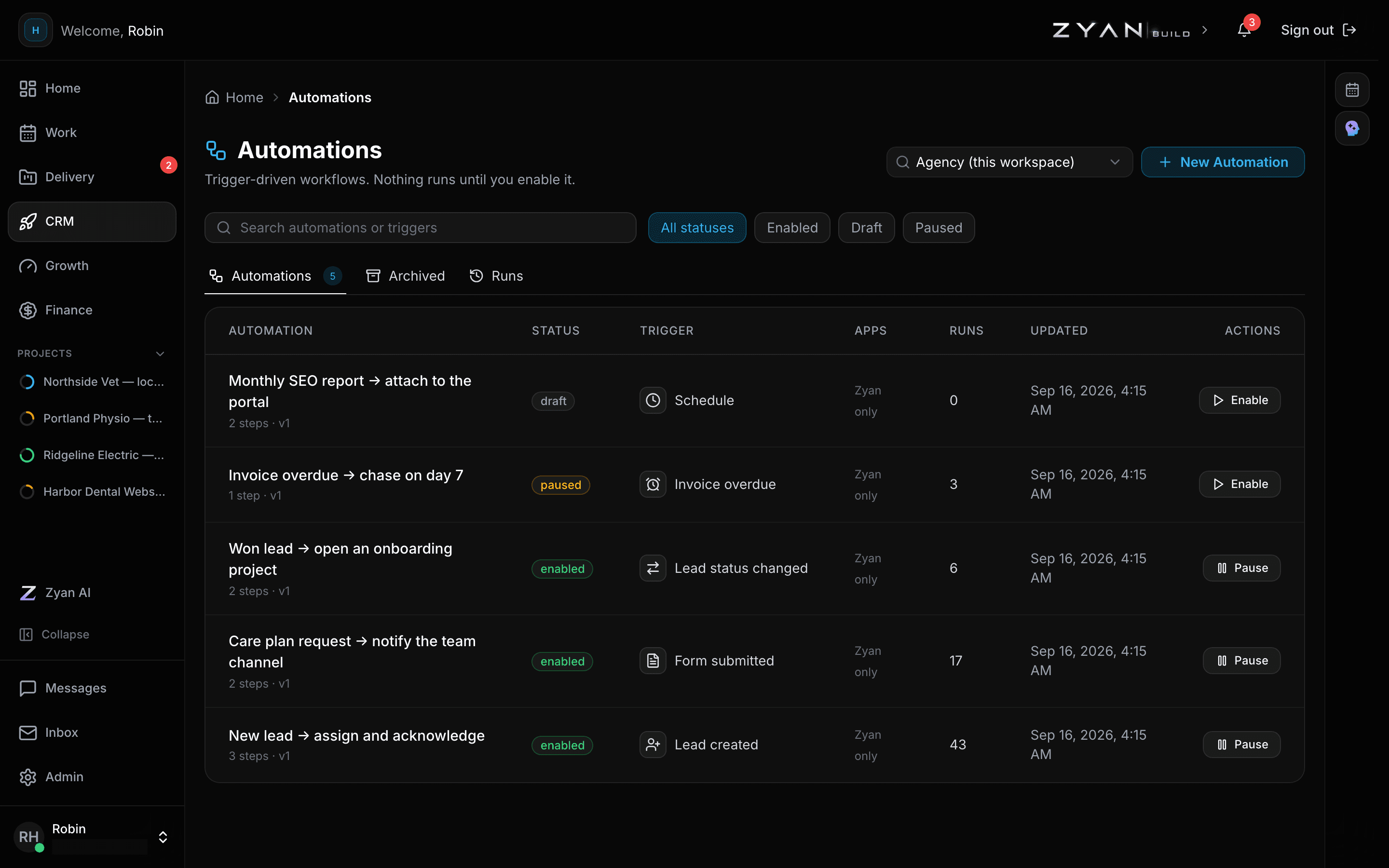
The three tabs
Open CRMAutomations.
| Tab | What it holds |
|---|---|
| Automations | Your live and draft definitions, with status and run counts |
| Archived | Parked definitions, with Un-archive |
| Runs | The ledger of recent runs, with each step's status |
Both the definitions list and the run ledger have a Status filter — All statuses, Enabled, Draft, Paused on the first; run statuses on the second.
Draft, enabled, paused, archived
| State | What it means |
|---|---|
| Draft | Saved, not running. A draft can be edited freely |
| Enabled | The published graph is live and the dispatcher runs it |
| Paused | Live but not firing |
| Archived | Parked. Un-archiving returns it to Draft, never straight to Enabled |
Saving a draft never changes live behaviour
What the dispatcher runs is the published graph — a frozen copy taken when you click Enable or Publish changes. Editing and saving a live automation does nothing to what is actually running until you publish. The top bar says Draft differs from live when the two have diverged.
Runs
Every firing is recorded in the Runs tab with its step statuses, so you can see which step stalled rather than guessing. If a run is missing entirely, the automation did not fire — that is a trigger problem, not a step problem, and the usual cause is that it was never enabled.
Agency scope and client scope
An automation's scope is set when it is created and cannot change afterwards. Some steps are agency-only: in a client-scoped workflow you will see messages like Slack steps are available for agency workflows only.
Decide the scope before you build
Because scope is immutable, discovering halfway through that your client-scoped automation cannot send the Slack message is a rebuild, not an edit. If the workflow notifies your own team, it is an agency workflow.
Two editors
Automations has two builders. Workspaces with the canvas editor enabled get a graph you lay out visually; the others get the older linear builder. Both produce the same thing — a trigger plus steps — and everything in these pages applies to either, but a screenshot of the canvas will not match every workspace.
Permissions
| Action | Needs |
|---|---|
| See automations and runs | The automations permission, view level |
| Create or edit | The automations permission, create/edit level |
| Read the Webhooks tile | Owner, or an automations editor with the permission |
| Manage webhook endpoints | Owner or admin |
| Connect most integrations | Owner or admin |
Troubleshooting
| Symptom | Cause | Fix |
|---|---|---|
| An automation is saved but never fires | It was saved as a draft and never enabled | Open it and click Enable |
| It fires, but the old behaviour | The draft was saved, not published | Click Publish changes; the bar reads Draft differs from live |
| Enable is disabled | A step's integration is not connected, or another blocker | Read the tooltip on the button; connect the flagged integration |
| The page says the workflow tables are not provisioned | The environment does not have them | It is not an empty state — contact support |
| An archived automation came back as a draft | Un-archiving always returns to Draft | Enable it deliberately |
| A step is unavailable in a client workflow | Some steps are agency-only | Rebuild as an agency workflow — scope cannot change |
| The editor looks nothing like a colleague's | The canvas editor is enabled per workspace | Both editors build the same thing |
In this section
Trigger, steps, connecting an integration mid-build, testing, publishing.
Triggers and steps referenceEvery trigger that can start a run and every step it can take.
Integrations directoryWhere providers connect, the three connection methods, pausing versus disconnecting.
WebhooksSigned addresses any tool can post to, and the key your deliveries are signed with.
Related
- How leads reach Zyan — what most automations are started by
- Post leads from your own form
- Team and permissions
- What to expect