
SEO Command Center overview
What the SEO Command Center does, the words it uses, and the order you work in — connect a website, research it, activate a strategy, act, publish, report.
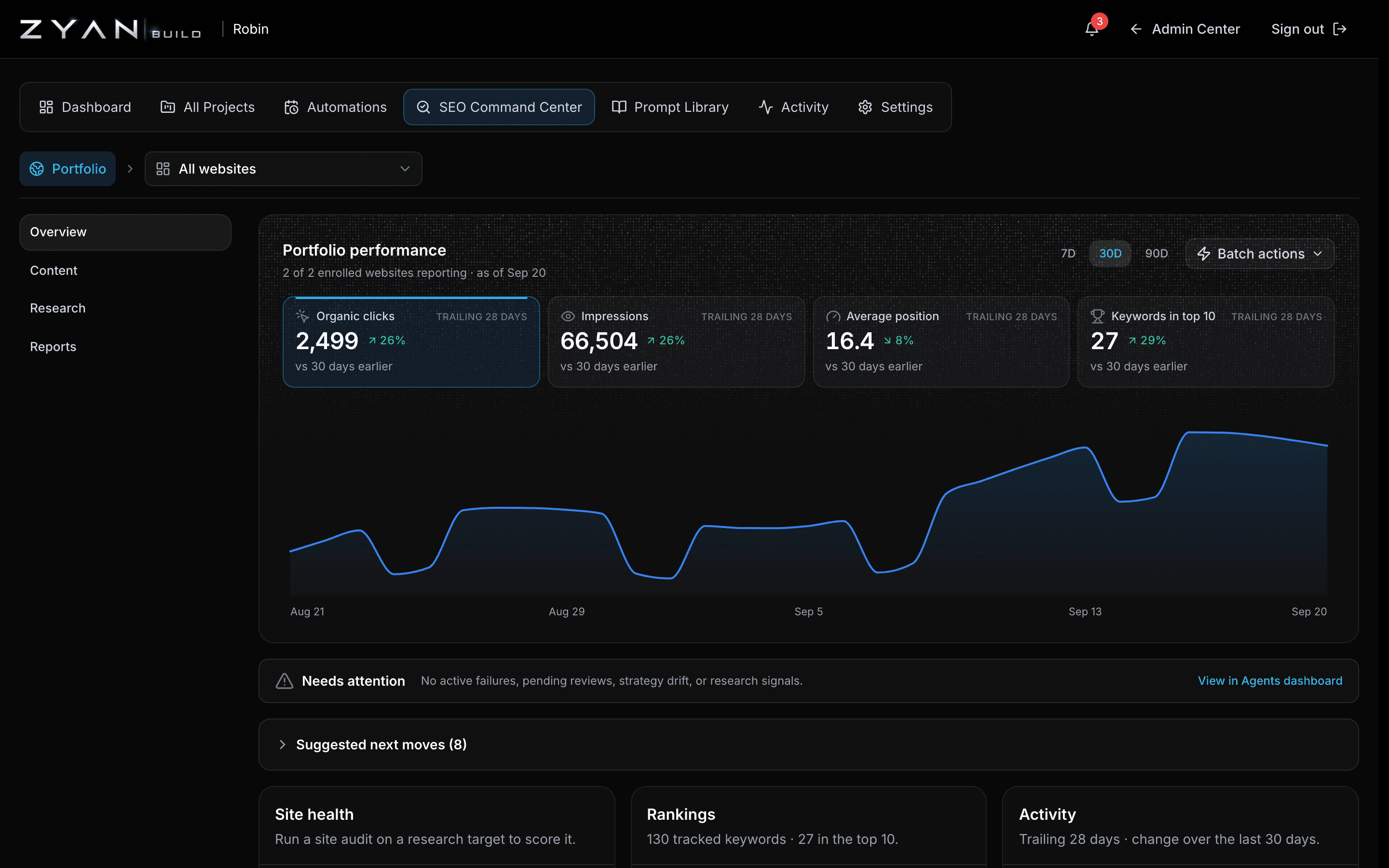
The SEO Command Center is where you run SEO for a client website end to end. It connects the data sources, learns what the business actually sells, researches the market, writes a strategy you approve, turns that strategy into work, and reports the outcome to the client. It lives at BuilderSEO Command Center.
It is the densest area of Zyan, so this page does one job: it gives you the vocabulary and the order of operations. Every other page in this section assumes you have read it.
Before you start
You need a plan that includes Builder, the builder permission, and a
Builder project for the website. Spending on research is restricted to workspace
owners and admins. If the Command Center shows a Not activated for this
workspace yet card, the area has not been switched on for your workspace —
contact support rather than working around it.
Enrol a site
Connect GSC and Analytics
Research
Market, competitors, keywords
Activate a strategy
Intent clusters and targets
Act
Recommendations and autoblog
Publish
Then the site deploy gate
Report
Share a public link with the client
The three scopes
The whole Command Center looks at one of three things at a time. Change it with the switcher next to Portfolio in the header.
| Scope | What it is | What you get |
|---|---|---|
| Portfolio | Every website at once | Overview, Content, Research, Reports |
| A website | A Builder project with a URL | The full tab set — Strategy, Content, Page, Technical, Results, Settings |
| A research target | A domain paired with one country market | The research surfaces only |
A research target does not have to be your client. You can type any domain into
the switcher and choose Research <domain> to open the target editor
prefilled, which is how you look at a competitor.
An unlinked research target locks the website tabs
On a bare research target, Strategy, Content, Page, Technical, Results and Settings are disabled with the tooltip Link this target to a Builder project to unlock. That is expected — a target is a domain, not a website you manage. Link it to a project when you want the rest.
The order of operations
Work in this order. Each step needs the one before it.
Connect the website
Google Search Console and Google Analytics, a niche, and a crawl of the site so the AI can read it. See Set up a website.
Research the market
Fill the Research brief, create a research target, then run research from StrategyResearch. See Research.
Activate a strategy
Research writes a draft. You review the intent clusters and the backlog, then press Activate draft. See Strategy.
Act on what it found
Work the queue on Technical, and turn keyword research into briefs with Use with Claude. See Recommendations.
Let the autoblog write
Create an Autopilot schedule on ContentSchedule and let Claude write and publish posts. See Autoblog.
Report to the client
Lock a baseline, generate the monthly report on ResultsReports, then attach it to the portal. See Reports.
The vocabulary
| Term | What it means |
|---|---|
| Research brief | Five fields that say what the business is — Niche, Target audience, Primary services, Secondary services, Target locations. Everything downstream is grounded in them |
| Research target | A domain paired with one country market, for example example.com · United States · en. Every keyword, gap and SERP surface reads from one. Creating it is free |
| Market | The country a target measures in. Country-only by design; 36 are available, each with a default language code |
| Research run | The staged pipeline that builds a strategy. A full run is ten stages; a monthly adjustment is three |
| Living strategy | The strategy for one website. It has an Active side, optionally a Draft side, a version number, a charter, a monthly focus, intent clusters and a backlog |
| Intent cluster | A named group of search queries with a business outcome, an owning page and supporting pages. Labelled Intent in the nav |
| Backlog item | A decision research proposes, at priority P0, P1 or P2. Open P0 items block activation until reviewed |
| Evidence lane | One of three refreshable data streams — Site knowledge (free crawl), Search evidence (paid), Content structure (paid) |
| Knowledge source | A document the AI has read — a crawled page, an uploaded file, a transcript, a URL or a note |
| Tracked keywords | The website's working keyword set. The In report switch decides which of them a client ever sees |
| Context pack | The set of SEO context files the project terminal loads when you open it, compiled from Zyan's SEO knowledge and this website's strategy |
| Dispatch | One attempt to write one blog post — minted, claimed by a runner, drafted, then published |
| Cost cap | The ceiling for a single research run, separate from the website's monthly budget and from a target's monthly ceiling |
What costs money and what does not
Paid research runs against DataForSEO, which Zyan provides. Every paid control shows an estimate and needs a second, confirming click.
| Free | Paid |
|---|---|
| Setup check, connection readiness | Pull search evidence (about $2 a run) |
| Crawl website (site knowledge) | Refresh structure (about $2 a run) |
| Google evidence, Deep Search Console pull, Free sources | Keyword Magic Find keywords and its two extend controls |
| Reading any cached research | Keyword Gap Compare |
| Track positions, Add to list | Keyword Overview analysis and Check live SERP |
| Cancelling a run | Domain Overview Refresh |
| Preview topic ideas, publish readiness check | A research run's paid stages, and monthly reports (AI credits) |
Dollar figures in the product are estimates
The roughly $2 per-run figures shown in the interface are client-side estimates. The server's own estimate governs what is actually charged, and a platform setting can change it. Treat them as guidance, not a quote.
Who can do what
Spending is owner and admin territory. Members can read everything and do the free things.
- Owners and admins: start and resume research runs, every paid refresh, Measure now, arming Auto-attach after QA, the generic-domain rule.
- Members: reading, Crawl website, Track positions, Add to list, cached reads, cancelling a run, and the whole Technical queue.
A member sees paid controls disabled with Owner only: running this spends the DataForSEO budget. They stay disabled for a moment on load while the roster is read, which is not an error.
Two platform-level states you cannot fix yourself
If the platform research credential is unavailable, the workspace shows DataForSEO research is paused for this workspace and every paid surface degrades to cached reads. Separately, Position Tracking, Organic Pages and Backlink Analytics are later-phase surfaces — confirm they are present in your workspace before planning work around them.
Deep links
Every surface, sub-tab and pane is addressable, so a link you paste into a
message reopens the exact view. Copy the browser URL. The keys you will see most
are ?project= (a website), ?target= (a research target), ?view= (the tab),
?strategyView=, ?researchView= and ?q= (a keyword seed). A URL never
carries both ?project= and ?target= — switching scope clears the other.
Troubleshooting
| Symptom | Cause | Fix |
|---|---|---|
| The Command Center shows Not activated for this workspace yet | The area is not switched on for your workspace | Contact support; there is no in-app toggle |
| Strategy, Content, Page, Technical, Results and Settings are disabled | You are on an unlinked research target | Link the target to a Builder project, or switch back to the website |
| Every paid button is greyed out | You are a member, not an owner or admin | Ask an owner to run it; free actions still work for you |
| Paid surfaces show cached data only | The platform research credential is unavailable | Wait — this is a platform state, not a workspace setting |
| Switching scope warns about leaving without saving | You have unsaved Settings edits | Save or discard first |
In this section
The setup chain in order — Google, the crawl, the brief, a research target, a budget.
The living strategyDraft and active sides, the next action, intent clusters and the backlog gate.
ResearchThe brief, targets and markets, run scopes and states, and the evidence behind them.
Keyword GapCompare against up to four competitors, and read the five segments correctly.
Acting on recommendationsThe Technical queue — filters, bulk actions, and how a fix reaches the website.
How a blog post is writtenThe five stages of a dispatch, the two writing lanes, and where the image comes from.
Set up an autoblog scheduleCadence, topic strategy, publish mode, and how to steer the topic queue.
Publishing and the site deploy gateWhat published means — committed, deployed, verified live — and the gate between them.
Monthly SEO reportsBaselines, the monthly autopilot, delivery QA and the public white-label link.
Local SEO and Map Pack trackingThe local rank grid, its cost model, and what the client is allowed to see.
Settings referenceEvery setting in the four groups, and which controls save on click.
Troubleshooting the SEO Command CenterEvery common failure grouped by cause — budget, permission, runner or deploy.