
Create a lead form
Build a hosted lead form end to end — fields and lead mapping, the link, what happens after submit, dedupe, consent, the auto-reply and styling.
A hosted lead form is a form you build in Zyan that lives on your own verified domain. It is the richest of the intake routes: it maps answers onto lead fields, merges returning visitors, emails the submitter back, and can trigger an automation of its own. This page walks the whole build in the order the editor puts it in front of you.
Before you start
You need the Leads plan feature and leads edit. To share the form
afterwards your workspace also needs a verified domain under
SettingsDomains — without one, the Share tab
offers no link at all.
It is worth knowing where this ends before you build anything. Publishing is only half of what makes a form live:
The form is Published
Your half. Publishing snapshots the fields visitors will see.
Your workspace can serve hosted pages
A verified domain, plus the platform switch Zyan arms for you.
Create the form
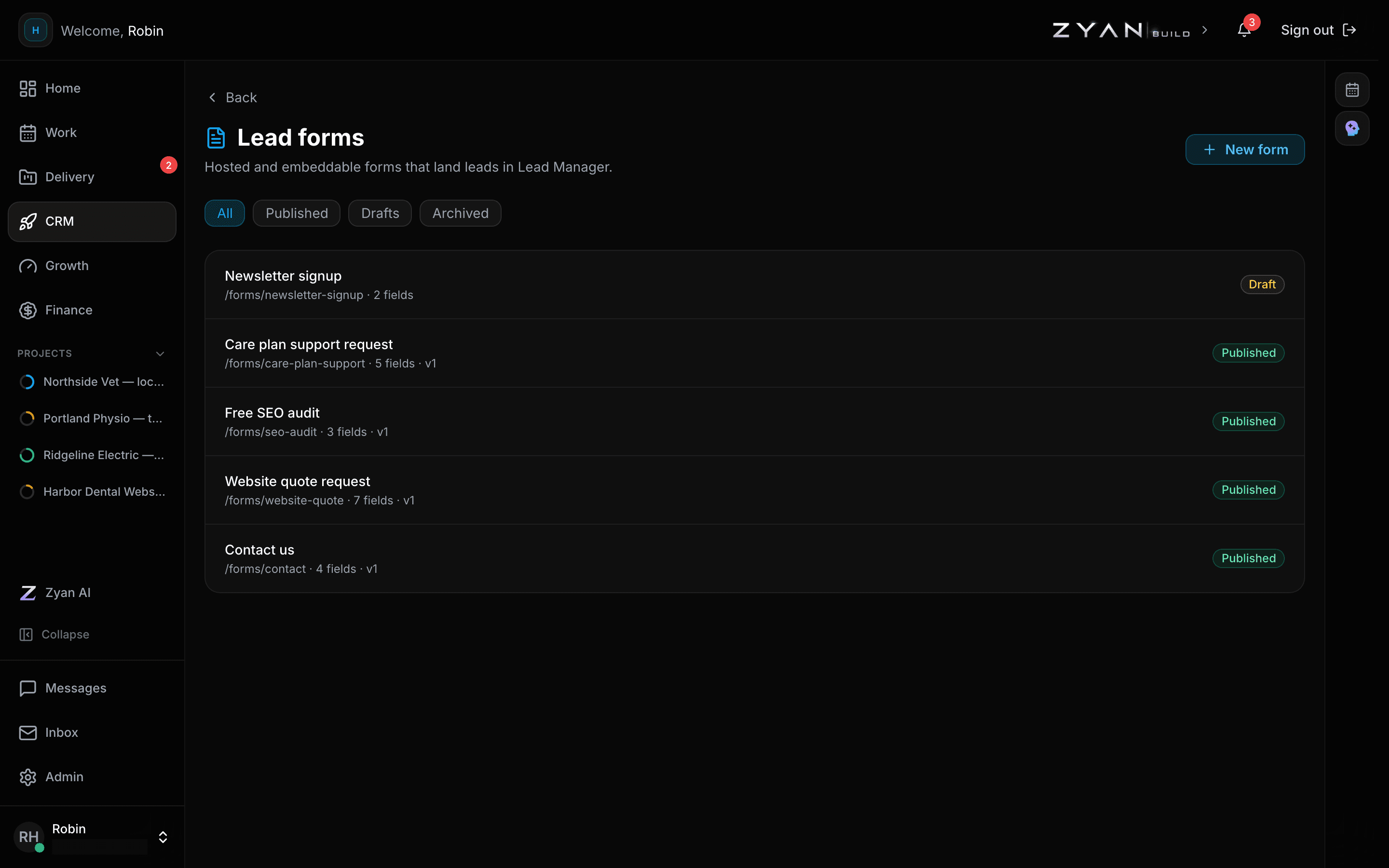
Open the Forms list
LeadsLead ManagerForms. The list has All, Published, Drafts and Archived lenses.
Click New form
Type a Form name. The link preview underneath shows the /forms/<slug>
path it will generate as you type.
Check the link preview
If the slug is taken, already used appears next to it and the modal will not let you continue. Change the name, or change the slug later on the Build tab.
Click Create form
You land in the editor with three starter fields — Name, Email and Message — already mapped.
Build: the fields
The Build tab has the field editor on one side and a live preview on the other. Use the add-field menu to add a question, then configure it.
| Setting | What it changes | Default |
|---|---|---|
| Section | Groups fields under a heading. This is also the unit One section per step uses. | — |
| Label | The question the visitor reads. Required, up to 120 characters. | — |
| Helper text | An optional hint below the field. Up to 500 characters. | — |
| Field type | What the field collects. Fourteen types are available. | Short text |
| Required | Blocks submission until the field is answered. | Off |
| Maps to lead field | Writes the answer onto a lead column — Name, Email, Phone, Company, Website or Message. Unmapped answers stay on the submission record only. | None |
| Options | The choices for Dropdown, Multi-select, Single choice and Checkboxes. Up to 50 options of 120 characters each. | — |
See Form field types for what each type collects and how it is validated.
Map the fields that matter, or the lead arrives blank
An answer that is not mapped stays on the submission record and never reaches the lead's Email, Phone or Company column. This is the single most common reason a form “works” but the leads look empty.
Each lead column can be claimed by one field only — once a field takes Email, that pill disappears from every other field.
Save is refused if any field is missing a label, or a choice field has no options. A form is capped at 60 fields, and a submission at 60 answers.
Details: the name and the link
The Details card carries the form's identity.
| Setting | What it changes | Default |
|---|---|---|
| Name | The form's display name, in the admin and on the hosted page. | — |
| Link slug | The path segment after /forms/. Lower-case letters, numbers and dashes, up to 64 characters. The word manage is not allowed. | — |
| Submit button | The label on the submit button. Up to 40 characters. | Send |
Changing the slug breaks every link you have already shared
The old path stops working immediately. If the form is on a client's website, in an email footer or in a social bio, change the slug before you publish the first time — not after.
If another form already holds the slug, saving fails with “A form with that link already exists — pick another slug.”
After submit
What the visitor sees when they send, and how the lead is recorded.
| Setting | What it changes | Default |
|---|---|---|
| Success message | Shown after a successful submission. Up to 2000 characters. | Thanks — we'll be in touch shortly. |
| Redirect URL | An optional https:// page to send the visitor to instead of showing the success message. | — |
| Lead source | How captured leads are labelled in Lead Manager: Website, Landing page, Referral, Event or Other. | Website |
| Merge returning visitors | Matches an incoming submission against existing leads by email or phone and updates that lead instead of creating a duplicate. | On |
| One section per step | Turns each section into its own step, with Next and Back. | Off |
| Consent note | Privacy or terms wording shown under the fields. Up to 500 characters. | — |
| Consent link | An optional https:// link to your policy, rendered with the consent note. | — |
Dedupe needs something to match on
Merge returning visitors matches by email or phone. If neither is mapped to a lead column, it has nothing to compare and every submission creates a new lead. Map at least one.
A Redirect URL replaces the success message entirely — the visitor never sees it. Use one when the thank-you page is doing work of its own, such as firing a conversion pixel.
Visitor auto-reply
An email that goes to the person who submitted, automatically.
Turn on Send an auto-reply
Subject and Message only appear once the toggle is on.
Write the subject and message
Subject up to 200 characters, message up to 5000.
Save changes
The auto-reply sends from your workspace sender, so set that up first under SettingsEmail identity — a reply from your own domain reads very differently from one from a shared platform address.
The auto-reply never blocks a lead
It is best effort. If the send fails, the lead is still captured. You will not lose a lead because an email bounced.
Design
The Design tab themes both the hosted page and the embed, with a live preview.
| Setting | What it changes | Default |
|---|---|---|
| Accent | Buttons, focus rings and selected choices. Leave it unset to follow your workspace accent. | Workspace accent |
| Corners | Square, Soft, Rounded or Pill. | Rounded |
| Typeface | System, Serif or Mono. | System |
| Theme | Auto follows the visitor's device. Light and Dark pin the scheme. | Auto |
The admin preview follows your admin theme
A form pinned to Light can still preview dark inside a dark admin. Trust the hosted page, not the preview, when you are checking a pinned theme — use Open preview on the Share tab.
Publish
Click Save changes
Click Publish
Publishing takes a snapshot of the fields. Visitors see that snapshot — never your unsaved edits.
Check the Share tab status pill
It tells you the truth about whether the link serves.
Publish is refused until all four of these are true:
- the link slug is valid,
- there is at least one field,
- every field is complete — a label, and options on choice fields,
- there is an Email or Phone field, so the lead can be reached and matched.
Edits are not live until you publish again
The hosted page serves the last published version. Save then Publish, and watch the version number go up (v2, v3 …). The Share tab will tell you “Save your changes before sharing” while you have unsaved work.
Taking a form down
| Action | Effect | Who can do it |
|---|---|---|
| Unpublish | The link shows a neutral page. Captured leads stay | leads edit |
| Archive | Retires the form. It moves to the Archived lens | Owner only |
| Restore to draft | Brings an archived form back as a draft | Owner only |
| Delete | Removes the form, its link and its submission history. The leads it captured stay in Lead Manager | Owner only |
Reading submissions
The Submissions tab shows the 50 most recent submissions: when each arrived, which form version it used, its source (hosted, embed, Typeform, Webflow, Tally or Fillout), and whether it created a New lead or matched a Returning one. A row reads Lead removed if the lead was deleted.
Spam protection
Hosted forms carry an invisible honeypot field. A bot that fills it gets a success-looking response and no lead is created. Submissions are also rate limited, per IP and per workspace.
There is no CAPTCHA option
A CAPTCHA or Turnstile setting is not built. Spam protection today is the honeypot, a keyword filter and the rate caps.
Troubleshooting
| Symptom | Cause | Fix |
|---|---|---|
| Publish is greyed out or refuses | One of the four publish checks failed | Fix whichever is named: slug, at least one field, complete fields, an Email or Phone field |
| Edits do not show for visitors | The hosted page serves the last published version | Save changes, then Publish again |
| “A form with that link already exists” | Another form holds that slug | Change the Link slug on the Details card |
| The lead's Email or Phone is blank | The field is not mapped to a lead column | Set Maps to lead field, save, publish |
| Duplicate leads for the same person | Merge returning visitors is off, or no Email/Phone field is mapped | Turn it on and map a matching field |
| A Maps to lead field pill is missing | Another field already claimed that column | Clear it on the other field first |
| The published link shows a neutral page | The form is Draft or Archived, there is no verified domain, or hosted pages are not armed yet | Read the Share tab status pill — it names which |
| Testing from one machine starts failing | You hit the per-IP submission cap | Wait for the hour to roll over |