
Clients and portals overview
The mental model behind clients, portals, projects and requests — what each one is, what it controls, and where in the admin you change it.
Four things sit behind every customer you run in Zyan: the client record, one or more client portals, the projects you deliver, and the requests and approvals that flow between you. They are separate on purpose, and knowing which one you are looking at saves most of the confusion people hit in their first week.
Before you start
Clients need the Clients permission and the crm_clients plan feature.
Portal work needs Client Portals (edit). The portal's Access and
Sections tabs are owner-only — team members with the Client Portals
permission see only Overview and Billing.
Client record
Internal only. No login exists yet
Portal
One login, per project or account-level
Invite
Email, with an optional onboarding pack
Discovery
Only where a pack carries a form. Per project
Live portal
Sections, services and billing you control
A client is not a login
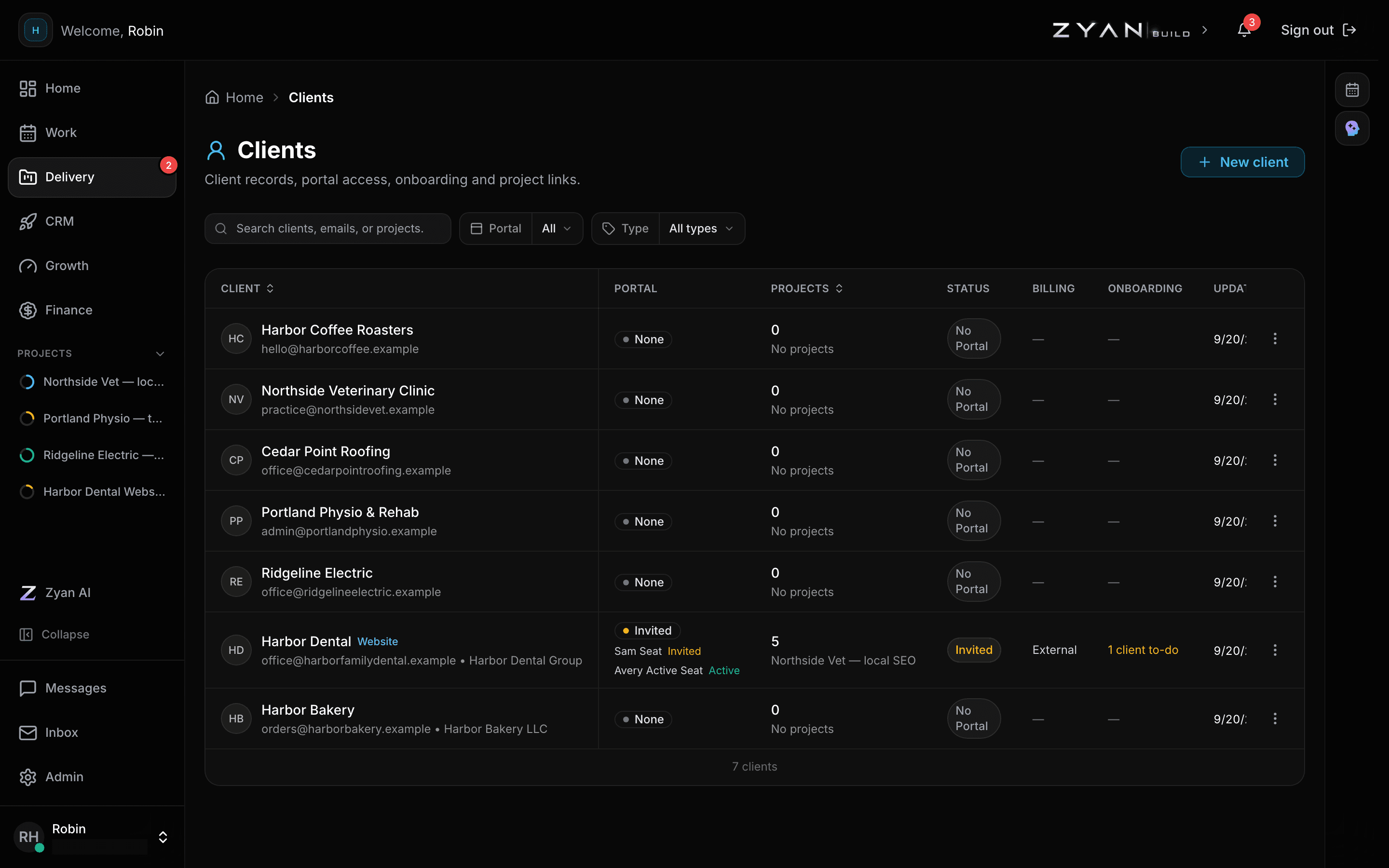
A client is your internal record: name, company, email, phone, notes and a status of active, lead or archived. Creating one creates nothing else — no portal, no invite, no login. The New client dialog says as much.
A client portal is the login. It lives under the client, and one client can hold several:
- One portal per project or website, each with its own sections, services and billing.
- Optionally one account-level portal with no project linked. The project scope picker labels it Account access. A client may only ever hold one of these — a second attempt is refused.
What a portal controls
Everything the client experiences is decided on their portal, not on the client record.
| Control | What it decides | Where you set it |
|---|---|---|
| Kind | Full portal, Leads, SEO, Backlinks or Ads. Minimal kinds land the client on their product surface and hide agency-workflow navigation | Settings → Sections |
| Sections | Which of the eleven portal areas are visible | Settings → Sections |
| Status and role | Whether the login works, and whether it is a client or admin role | Settings → Access |
| Seats | Extra logins on the same portal, up to five beside the primary | Settings → Access |
| Notification emails | Which categories of email this client receives | Settings → Access |
| Billing | Subscription, plan cards, payment links, invoices | Settings → Billing |
| Services (add-ons) | Which purchased or granted services appear, per website | Client visibility |
Where each control lives
Open a client from DeliveryClients and you land on a page split into section pills:
- Overview — portal access card, the onboarding timeline, billing summary and plan-change requests.
- Client visibility — the add-on queue and a per-service, per-website matrix that answers "what does this client actually see".
- Projects, Activity, Schedule — the work, the interaction history and scheduling. Growth is owner-only.
- Settings — the portal settings panel (Overview, Access, Sections, Billing), the portal lifecycle actions and the danger zone.
Check your work without logging in as the client
Use Client visibilityPreview as client for a read-only snapshot of the client's portal under their own permissions. Open live portal takes you to the real thing. Check the preview before you send an invite.
Projects and portals are linked, not the same
A project is your delivery record. A portal is a login. Linking them is what makes several features work at all:
- Approvals are project-scoped. A portal with no linked project cannot receive one.
- The client's Discovery Interview is per project.
- Reports, checkpoints and client tasks hang off the project and surface in the linked portal.
You can create a project first and attach a portal to it later, or create the portal and link it when the project exists.
Requests and approvals
Two different directions of travel:
- A request comes from the client — a revision or change they ask for. They raise it in their portal, and it lands in your Requests inbox.
- An approval goes to the client — work you need signed off, with an optional checklist. They answer Approve or Request Changes.
- A client task also goes to the client, but it is a to-do rather than a sign-off.
The client's side in one paragraph
Your customer opens the invite, sets a password, and — if you attached an onboarding pack with a discovery form — answers the questionnaire. They land on Home with a to-do card and recent activity. Their left navigation is whatever your section toggles allow: Home, Projects, Tasks, Strategy Center, Requests, Messages, Announcements, Analytics, Advertising, Plan & Billing and Settings. Reviews (your approvals) live under Tasks → Reviews. The whole thing carries your logo, colour and legal links.
Troubleshooting
| Symptom | Cause | Fix |
|---|---|---|
| A new client has no portal | Creating a client never creates a login | Use Create portal on the client's Overview tab |
| "This client already has an unassigned portal" | A client may hold only one account-level portal | Link the next portal to a project instead |
| Access and Sections tabs are missing | Those tabs are owner-only | Ask a workspace owner to make the change |
| The client sees a section you turned off | Section flags hide surfaces, not the records behind them | Turn the matching notification category off under Settings → Access too |
| Request Approval is disabled | The portal has no linked project | Link a project to the portal first |
In this section
The directory, its filters and row actions, and what deleting a client removes.
Create a client portalGive a client a login, link it to a project, and send the invite with a pack.
Control what a client seesPortal kind, sections, access and seats, services per website, and retiring a portal.
Brand the portal and use your own domainYour logo, colour and legal links, then a hostname you own.
The requests inboxTriage what clients ask for, and keep internal notes out of their view.
Approvals and client tasksAsk for a sign-off, or give the client a to-do, and know which one you need.
Sell services from your storefrontA public product page that creates the client, portal and onboarding after a purchase.
Troubleshooting clients and portalsEvery refusal, missing button and surprise, grouped by where it happens.