
Voice agents overview
How the voice surface fits together — agents, products, context packs, campaigns and preflight — and what has to be true before a phone actually rings.
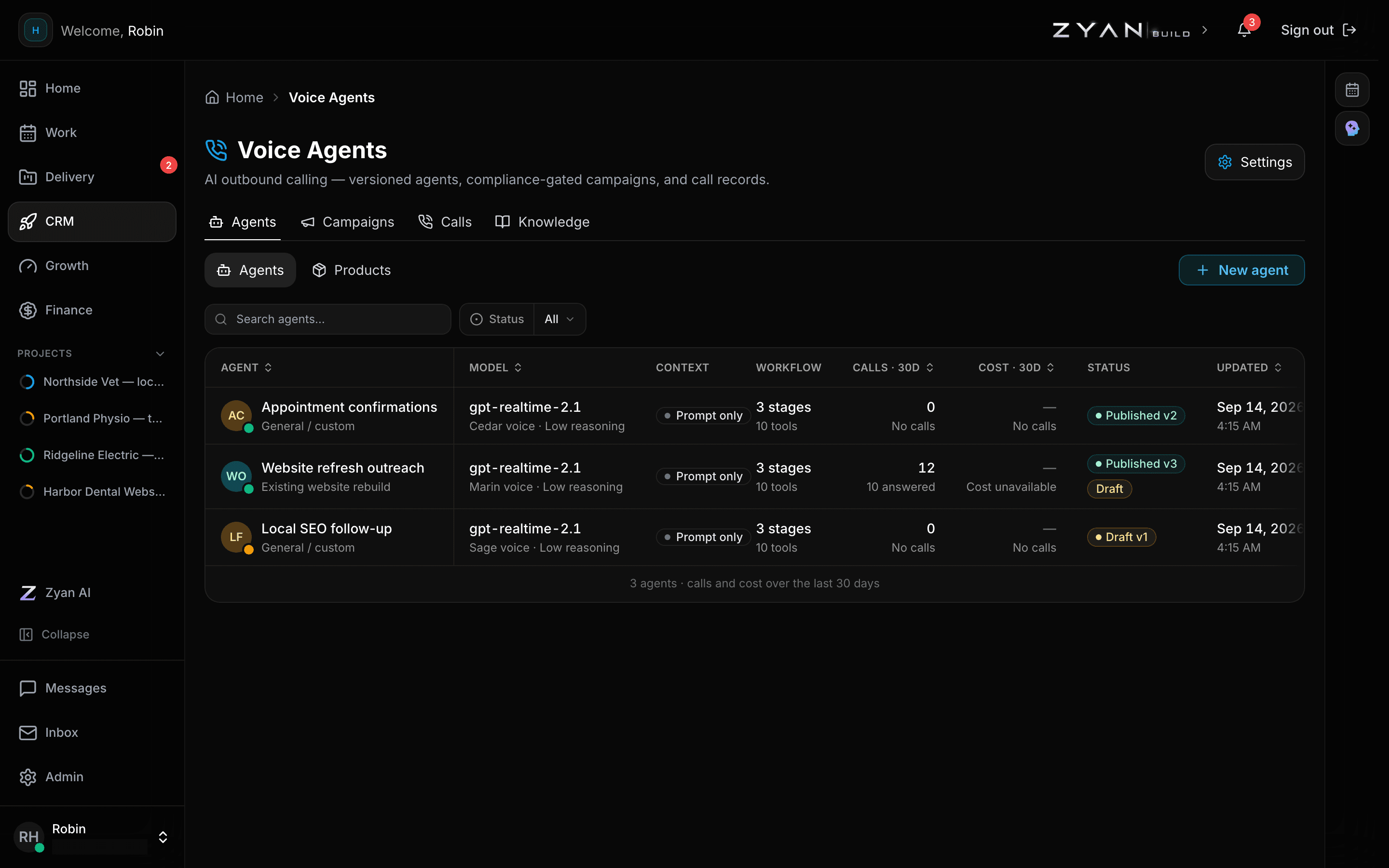
Voice Agents is where you build an AI that makes phone calls, decide who it is allowed to call, and read back what happened on every call. It lives under CRMVoice Agents: four tabs in one workspace, and almost every problem people hit comes from not knowing which of the four owns the thing they are looking for.
Before you start
Voice Agents needs the Voice plan feature and the voice permission.
Owners have it automatically. On the Base plan the nav item is hidden entirely
and a deep link shows a plan notice instead of the workspace.
Agent
Published version
Campaign
Agent + list + window
Preflight
Blocks on any error
The call
Runs your workflow stages
Outcome
Transcript, disposition, handoff
The four tabs
| Tab | What lives here |
|---|---|
| Agents | The agents themselves, and — behind a pill at the top — Products, the offer playbooks an agent may quote |
| Campaigns | Who gets called, by which agent, from which number, inside which hours |
| Calls | Every call the workspace has placed, with transcripts and outcomes |
| Knowledge | The context library and the packs you attach to agents and campaigns |
The Settings button in the header takes you to SettingsVoice & Telephony, which holds everything that applies to the whole workspace rather than one agent.
Four things, and what each one is for
People conflate these constantly, so it is worth being blunt about the difference.
- An agent version is the caller: who it says it is, how it talks, what it is allowed to do. Versions are numbered and go draft → published → archived.
- A product is the offer: FAQs, objections, pricing and claim rules. It is versioned the same way. Product answers stay authoritative — context that is not supported by the product never becomes a claim on the call.
- A context pack is a named bundle of approved knowledge the agent may search mid-call. Attached per agent version, and optionally per campaign.
- A campaign is the run: the lead list, the caller number, the calling window and the caps.
A campaign pins one published agent version and one published product version. Both of them. That is the most common reason a new campaign cannot be approved.
How a call actually happens
You publish an agent version and a product version
Drafts are invisible to campaigns. Publishing archives whichever version was published before it.
You create a campaign and import leads
The campaign pins the agent, the product, the caller number, the calling window and the caps.
You run preflight
A deterministic server-side check. Errors block; warnings need a typed acknowledgment.
You approve, then start
Approval snapshots the configuration into an immutable version. Preflight re-runs at launch.
The dispatcher dials inside each lead's local calling window
Preflight runs again before every single dial. Dialing is not instant — it proceeds on a dispatcher tick.
Live dialing is armed by Zyan, not by you
The default runtime simulates calls with no telephony egress. Real dialing to
the public phone network is gated at the platform level and cannot be switched
on from Settings. Until it is armed for your workspace, preflight reports
live_calls_disabled and nothing leaves the building. Use Voice Lab, scenario
simulation or a saved test number in the meantime, and contact Zyan support
about live calling.
What you can do without live calling
Quite a lot, and it is the right order to work in anyway:
- Voice Lab — a typed rehearsal against a selected agent version.
- Scenario simulation — deterministic, zero egress, no call placed and production suppression untouched.
- Live usability test — a real call to a saved test number, when Enable live usability tests is on in Settings → Voice & Telephony and a caller route is ready.
Who can do what
| Action | Needs |
|---|---|
| See the workspace | Voice plan feature plus the voice permission |
| Create or edit an agent, product or campaign | Voice edit permission |
| Run a preflight | Voice edit permission — viewers see results only after someone else runs one |
| Activate the emergency stop | Voice edit permission |
| Connect Twilio or Telnyx | Workspace owner |
If the tab says nothing is dialing, believe it
Where the voice functions are not deployed in an environment, the UI says so outright: The voice-agent functions are not deployed in this environment yet. Nothing is dialing. That message is accurate, not a loading state.
Troubleshooting
| Symptom | Cause | Fix |
|---|---|---|
| Voice Agents is missing from the sidebar | The workspace is on the Base plan, or the voice permission is not granted | Check the plan and your permissions with the workspace owner |
| A new campaign will not offer your agent | No version of it has been published | Open the agent, save the draft, then Publish… |
| A campaign cannot be approved even though the agent is published | The product version is not published | Publish a product version and re-select it on the campaign |
Preflight reports live_calls_disabled | The platform voice gates are in their safe default posture | Live dialing is armed at the platform level — contact Zyan support |
| The tab loads but says nothing is dialing | The voice functions are not deployed in this environment | Nothing you change in the admin will fix it; contact support |
In this section
Identity and voice, how it talks, what it may do, and publishing a version.
Writing the call workflowTurn the call into ordered stages with objectives, budgets and exit criteria.
Build a knowledge base for your agentsApproved sources, context packs, and testing what the agent can retrieve.
Test an agent before it calls anyoneTyped Voice Lab, zero-egress simulation, and a real call to a test number.
Voice campaignsWho gets called, the calling window and caps, approval and launch.
Preflight check referenceEvery code that blocks a campaign, and the exact change that clears it.
Connect Twilio or TelnyxBring your own carrier so its numbers become caller IDs.
Reading call recordsTranscripts, extracted outcomes, the CRM projection, and opting a number out.
Voice & Telephony settingsThe workspace-wide policy every agent and campaign inherits.
Voice agent troubleshootingNothing dialing, a campaign that will not approve, leads stuck at pending.
Related
- Triggers and steps reference — the Voice call outcome trigger is the handoff out of a finished call
- How leads reach Zyan — where the numbers you dial come from
- Team and permissions
- What to expect