
Set up your workspace
A tour of Settings — how the four groups are organised, which panels are personal and which are owner-only, and what your business type pre-loads.
Everything that configures a Zyan workspace lives on one page. Settings is a single screen with a grouped sidebar, and each section is a URL hash rather than a separate route — so any panel can be bookmarked, shared with a teammate or linked from a runbook.
Open it from your avatar menu, or from Settings in the sidebar.
Before you start
Most Workspace panels are owner-only. If a section is missing from your sidebar, your role does not allow it, your plan does not sell it, or the platform does not enable it for your workspace — see Plans, credits and seats.
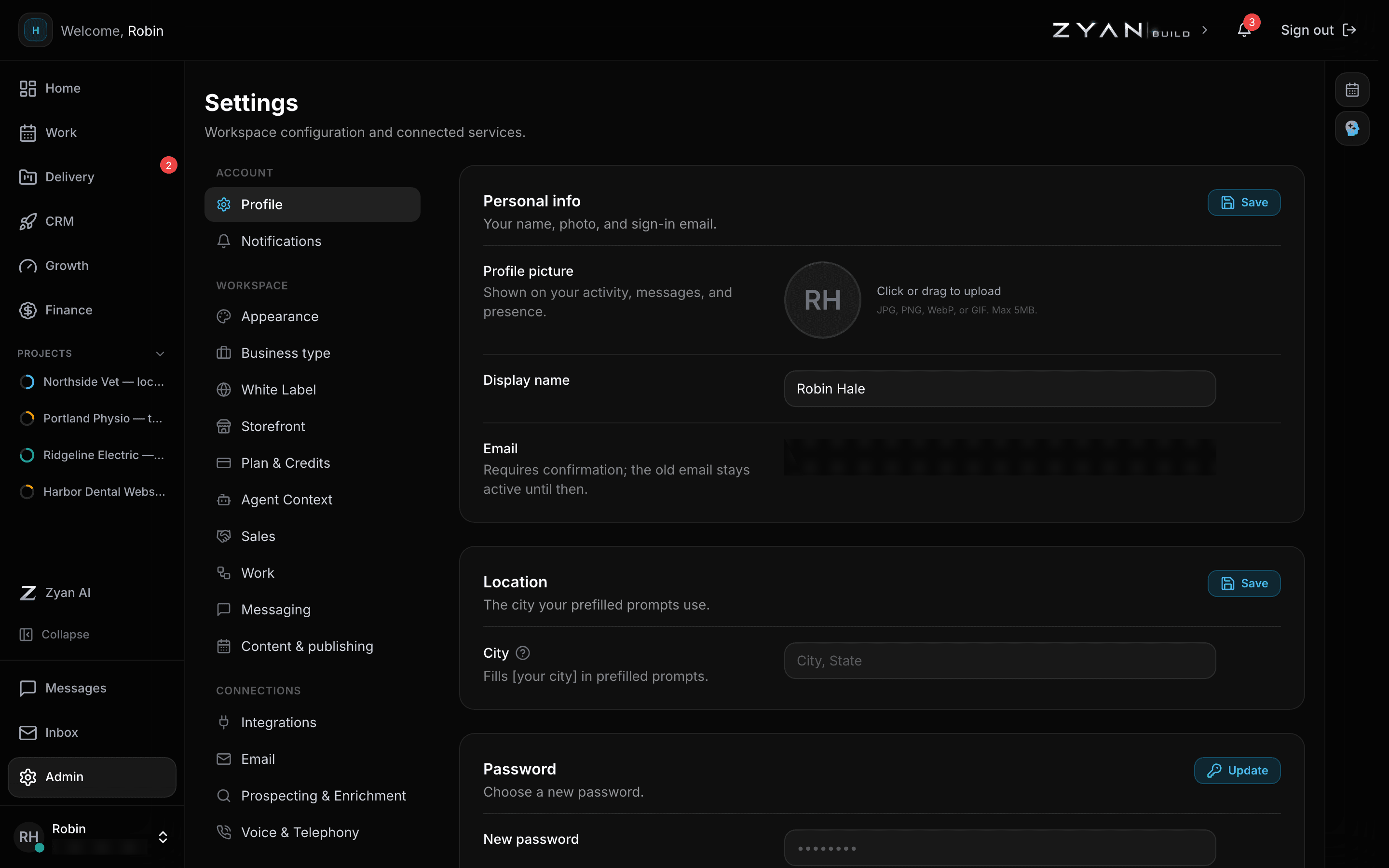
How the page is organised
The left rail groups sections into four bands. Below large screens the rail collapses into a single dropdown picker at the top of the page.
| Group | What it is for |
|---|---|
| Account | You, personally — your profile, your notifications |
| Workspace | The agency: identity, business type, white label, plan, defaults |
| Connections | Outside services: integrations, email, prospecting, telephony |
| Apps | The Zyan desktop app |
Every section and who sees it
| Section | URL hash | Who can open it |
|---|---|---|
| Profile | #profile | Everyone |
| Notifications | opens /admin/notifications | Everyone (your own only) |
| Appearance | #appearance | Everyone for the theme; the Brand card is owner-only |
| Business type | #niche | Owner |
| White Label | #white-label | Owner |
| Storefront | #storefront | Owner, and only when the plan sells Storefront |
| Plan & Credits | #plan-credits | Workspace owner only |
| Agent Context | #agent-context | Owner, or members with DM-automation access |
| Sales | #sales | Owner |
| Work | #work | Owner |
| Messaging | #messaging | Owner |
| Content & publishing | #content-publishing | Owner, or permitted Content Center members |
| Integrations | #integrations | Owner, or members with calendar, files, automations or Content Center access |
| Voice & Telephony | #voice-telephony | Owner, or members with settings or voice access |
| Desktop app | #desktop | Everyone, on every plan |
Two entries in Connections are signposts rather than sections: Email deep-links to OutboundSettingsEmail, and Prospecting & Enrichment deep-links to OutboundSettingsAutomation controls. The real editors live there.
Integrations carries one more gate that is not yours to set: the section renders only while the platform enables it for your workspace.
Bookmark the hash, not the page
/admin/settings#white-label reopens exactly where you left off. Take the hash
from the sidebar rather than typing it — a hash Zyan does not recognise silently
lands on Profile and is stripped from the URL.
Personal versus workspace
Two panels in Account are yours alone. Nothing you change there affects a teammate.
- Profile — your photo, display name, sign-in email, password, sign-in methods and the Sign out all sessions button.
- Notifications — your own categories and whether email arrives immediately or as a daily digest. An owner cannot edit a teammate's notification preferences; everyone manages their own.
The display preference on Appearance (System / Light / Dark) is also personal, even though the section sits under Workspace. The same preference is behind the Dark mode toggle in the avatar menu.
Everything else on the page is workspace-wide and written by the owner.
Two Profile cards are not personal
Portal defaults and Payroll schedule sit on the Profile page but change the whole workspace — the default onboarding-email setting for new client portals, and the pay-period clock that payroll, digests and reminders all read. Both are restricted to the owner and full-access admins.
Business type and what it pre-loads
The one panel worth opening on day one is SettingsBusiness type. Pick the pill that matches your agency and Zyan fills in a matching set of defaults.
The eight types are: General services business, Web design & SEO agency, Accounting & tax firm, Digital marketing agency, Content creation studio, SEO & growth agency, Law firm or legal practice, and Consulting & coaching practice.
Picking one fills in the intake questionnaire, an onboarding pack, client task templates, task types, lead tags, delivery-step defaults, board stage labels, the outreach ICP, the billing category order and the AI's persona.
Open the Business type panel
Go to SettingsBusiness type.
Click the pill that matches your business
Applying starts as soon as the selection changes.
Read the description under the pills
It confirms what the type covers before you commit to it.
Click Apply defaults whenever you want to re-fill gaps
Running it twice changes nothing, so it is safe to re-click.
Settings reference
| Setting | What it changes | Default |
|---|---|---|
| Your business | Which of the eight business types your workspace is. Changing it re-runs the fill for the new type. | Unset, which reads as General |
| Apply defaults | Re-runs the fill for the type you already selected. Safe to press repeatedly. | — |
| Defaults | Read-only status line reading either “Defaults applied” with a date or “Defaults not applied yet”. | Not applied yet |
Fill mode
This is the rule that makes the panel safe to press: defaults only fill. Anything you have already authored is left exactly as it is, and switching to a different type is also a fill, not a replacement. Your own task types, tags and templates survive.
The consequence is that there is no one-click reset. A true replace mode is not exposed in the interface, so a workspace that has been running for months will pick up only the gaps.
Pick the type before you build anything custom
Because fill mode never overwrites, the earlier you choose, the more you get. A brand-new workspace receives the whole set; one with six months of hand-built task types receives almost none of it.
Workspace defaults worth a second visit
Four panels shape work you have not created yet. None of them blocks your first client, and all of them are owner-only.
| Panel | What it pre-fills |
|---|---|
| Sales | Contract term and build commission on new deals. Existing deals keep their own terms. |
| Work | Up to six project workflows — each with a label, description, five section switches and a starting task type. |
| Messaging | Which phone lines appear in Messages, and per-member visibility for Instagram, Facebook and WhatsApp. |
| Content & publishing | Working timezone, default account, default reviewer, and an optional preferred posting window. |
Social visibility is not in the permission grid
Instagram, Facebook and WhatsApp visibility inside Messages is set per member under SettingsMessagingTeam access and nowhere else. Those three rows are opt-out — a teammate nobody has touched there can see everything their Inbox permission allows.
Troubleshooting
| Symptom | Cause | Fix |
|---|---|---|
| A Settings link opens Profile instead of the section I expected | The hash is not a registered section — a typo, or a retired one like #logs or #sign-in-methods | Navigate from the sidebar and re-bookmark; the bad hash is stripped automatically |
| “Access Restricted — You do not have permission to manage this workspace settings section” | A non-owner deep-linked to an owner-only section | Ask the owner to make the change, or have them turn on Allow full access. Plan & Credits stays owner-only even then |
| The Settings sidebar is missing entirely | Only one section is visible to you | Expected behaviour — the rail hides when there is nothing to switch between |
| An old bookmark still works but lands somewhere new | Retired hashes redirect: #outreach and #agents to Prospecting, #brand-voice to Agent Context, #analytics, #calendar and #billing to Integrations | Re-bookmark from the sidebar |
| Business type shows “Defaults not applied yet” after I picked one | The apply did not complete | Press Apply defaults; re-running is harmless |
| Digest emails and payday dates arrive at the wrong hour | The payroll schedule is still on the UTC default | Settings → Profile → Payroll schedule: set Timezone, save, and check the Next paydays preview |